Wednesday, August 19, 2015

Bolikhamsai improves four ecotourism sites

Information, Culture and Tourism Department of Bolikhamsai province, in Lao PDR, will improve four ecotourism sites that could be linked up with trips to other destinations in the country.
Lao News Agency reported the four ecotourism sites that will be developed are Meuangmoun Choumthong area in Viengthong district, the Kaengsaitean area in Khamkuet district, Thamphasing cave in Bolikhanh district and the Nam Tone waterfall in Pakkading district.
The province’s deputy governor, Souvanny Xayana, said Bolikhamsai province has a high potential for ecotourism with many tourist sites scattered around the province.
“We have a plan to improve and develop tourism sites to support the influx of both domestic and foreign tourists.”

inside no 1The issue hindering their development is the lack of adequate transport between the destinations.
He added: “An ecotourism site in Thaphabath district has already been developed and has attracted tourists from both nearby provinces and neighbouring countries. It has generated income for local people.”
Bolikhamsai is located in the heart of the country bordering Xiangkhouang province to the northwest, Vietnam to the east, Khammouan province to the south, and Thailand to the west. The province includes the Annamite Range, stretching east to Vietnam, while to the west is the Mekong River that marks the border with Thailand.
Source: Vientiane Times

Wednesday, August 12, 2015

The Elephant Festival Sayabouly

The Asian elephant has its day, actually two, in mid-February when Laos turns its eyes to Sayabouly Province and the Elephant Festival. Launched in 2007, the annual fete draws more than 80.0000 elephant fans to the ceremonies, processions, and performances to pay tribute to the national symbol of “The Land of Million Elephants”.
Home to the country’s largest pachyderm population, Sayabouly Province is the natural choice to host this growing event that also aims to raise awareness about the need to protect the endangered Asian elephant, which has played such a vital role in Lao people’s livelihoods, culture and heritage.
Elephant Festival descript
After an opening ceremony, a procession of elephants enters the host village through a bamboo arch. The elephants bathe and are blessed by monks, with participants making merit in a baci ceremony, before with the election of the “Elephant of the Year”. Then the entertainment begins: pachyderm performances, musical concerts, outdoor films, dance shows, and fireworks displays in a carnival atmosphere that includes elephant rides and a “Fun Fair”. After the second day’s procession and religious ceremony, mahouts round up their massive mammals for a day of elephant entertainment and visitor education capped with the crowning of the elephant of the Year. For an even more authentic experience, visitors can book a village home-stay.
Source: tourismlao.org

Wednesday, August 5, 2015

Wat Phou Festival

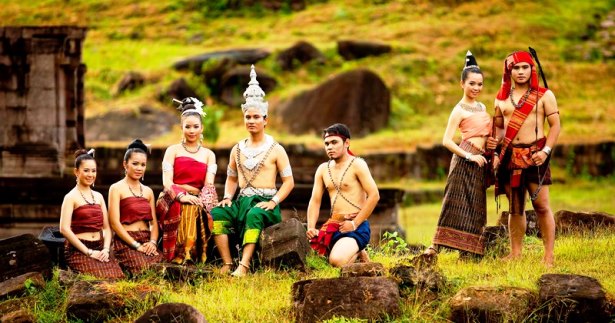
The annual Vat Phou Festival takes place in February each year, coinciding with the Buddhist festival of Makha Busa and bringing believers from near and far to attend a ceremony and take part in festivities. The Vat Phou Festival 2016 will take place on 03 February 2016.
Since the ancient Khmer ruins of Vat Phou were listed as a World Heritage Site by UNESCO, government authorities have been working hard to promote tourism in Champasak and the surrounding area. The Vat Phou Festival is also important for helping Lao people to understand the cultural significance and historical importance of the magnificent site.
Photos: Adul Tanthakosai
Alongside the sound and light show, the Vat Phou Festival will also include singing and dance performances by performers from Cambodia, Thailand and Vietnam as well as Laos. Most of the performers are local people from Champasak who have trained for the performance alongside their foreign counterparts. There will also be a large market for facilitating the sale of domestic products and handicrafts.
Vat Phou is open daily from 08:00 to 1800 and admission is around 30,000 kip. The Vat Phou complex is about 8 km from the main Champasak town, south of Pakse. For more information on ideas for a trip to the south of Laos, please contact us:info@asiarevealtour.com
Based on: Yingchockchai Group, Vientiane Mai
Photos: Adul Tanthakosai

Monday, August 3, 2015

Boun Khao Phansa celebrated in Laos

“The festival is an important opportunity to make merit for me and my family. I usually join my mother to attend almsgiving at the temple every Buddhist Lent,” a resident of Phonsinuan village named Ms Kaikeo said after she finished presenting her offerings.
This was her special day as she had to get up at 5am to prepare her offerings for the monks and novices for Boun Khao Phansa.
The monks told her that her actions were one way to seek mindfulness and happiness in this life and the next, but it is also about making merit for spirit relatives and those who transgressed or acted badly in a past reincarnation.
Each year of Buddhist Lent (Boun Khao Phansa ) believers get up early to take their buckets with offerings and a couple of large candles to go to the temples at seven in the morning.
These offerings will provide convenience for the monks and novices during the three months of studying the Buddha’s teachings, keeping the precepts and pausing for meditation.
Baci ceremony
At 8am, senior monks in local temples gave five commitments to lay people to encourage them to make merit and give blessings.
After that believers are allowed to give arm directly to monks, before they sprinkle water from a small bottle onto the ground to ask Ngamae Thorani (a female guardian spirit living under the Earth), telling her to transfer their words to their relative spirits to come to receive their offerings.
During Buddhist Lent monks and novices have to stay in their monasteries to study the Buddha’s teachings, keep the precepts, meditate and live up to their commitments for the duration of the rainy season.
Also, monks and novices are banned from travelling except in the case of specific urgent matters in the scripture such as family illness but even then they are only allowed to leave the temple for a period of seven days.
Monks and novices are also prohibited from returning to lay life outside the temple while ordinary people are prohibited from getting married during this period as it is believed that they won’t achieve success in their family life if they marry during the rainy season.
Source: Vientiane Times